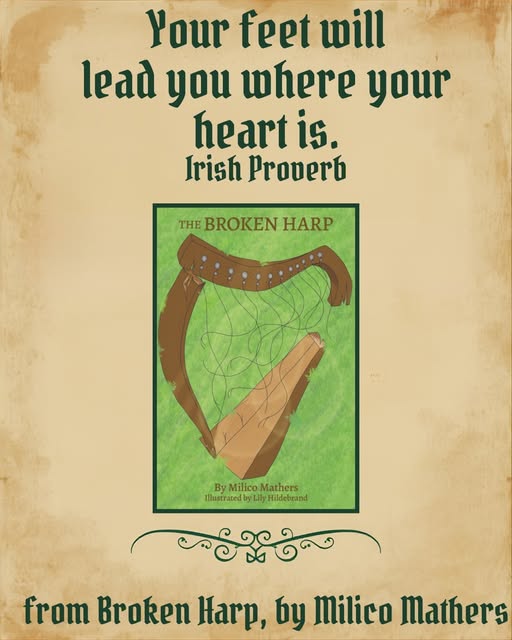
Note to Parents and Students about The Broken Harp: In the summer of 2019, my husband and I traveled to Scotland and Ireland as a celebration of his retirement. For me, Scotland made good memories, but Ireland held a beauty like home. Not a home I’d ever experienced, but a home of my soul.
On the way to Belfast from Scotland, an Irish woman struck up a conversation with me as we traveled across the Irish Sea. She commuted via the waterway a few days a week to work in Scotland as a nurse. She told me about her uncle who had joined the British effort during World War II and died in battle. “We were not allowed to speak his name when we were growing up because he was a Catholic who fought for the British. But I think that was wrong. He was a hero.” That conversation produced the seed from which The Broken Harp sprouted.
The sprout grew into a minor obsession with the history and culture of my Irish forebears. Ireland is a country we often overlook in studies about World War II, what the Irish called The Emergency. That’s unfortunate because Ireland’s history during that time is fascinating.
Set in Ireland in 1941, The Broken Harp follows protagonist 12-year-old Brian as he strives to identify and pursue goodness during a time of great challenge. Brian’s father has been arrested, accused of belonging to the Irish Republican Army. Dad, a drywall stone mason, had been the keystone of the family, the rock that held the other pieces in place. Without their patriarch, the family struggles to find what is right and good.
Ireland’s government saw the IRA as a threat to the neutral stance the country was trying to maintain even as it behaved favorably to the British war effort. The government didn’t want to become embroiled in a war less than 20 years after gaining their independence from England.
Because Germany had assisted Ireland during the war for independence, many Irish citizens favored the German cause. Even so, many Irishmen joined the British effort. Despite or, perhaps at least to some degree, because of the division among the people, the government decided to spend the war years preparing to defend the island from invasion by either side.
Ireland’s refusal to fight on the side of the British resulted in an embargo of necessary goods, gasoline, fertilizer, seed, and foods like flour. The Broken Harp illustrates the hardship the embargo caused as well as support for Germany among those still resentful of British abuse.
I avoid any vivid description of that abuse, which would render the work unsuitable for young readers and most older ones as well.
The pages contain a sprinkling of American history and culture with the introduction of a crop duster/knuckle-ball pitcher from Iowa who joined the RAF to fight the Nazis before Pearl Harbor.
Inhabitants of the Emerald Isle immigrating to America represent a bigger version of “Go west, young man” than we Americans experienced ourselves. The Irish in America today outnumber the Irish in Ireland by seven to one. The primary characters in this book do indeed go west. The American Dream is to make a better life, a free life, a thriving life. No matter our nationality, we can find that life in Christ. To follow Christ, we seek truth, goodness, and beauty.
This book is the second in a series that began with Wandering Swallow, a story about a young girl attempting to escape North Korea during the famine of 1995. Her journey with her grandfather takes her through China to an unexpected destination, one of faith. Hana finds truth on that journey. In The Broken Harp, our protagonist Brian seeks goodness.
The third book in the series Counting on Jude is currently in process with hopes of publication in 2027. That book marks the completion of the series encompassing truth, goodness, and beauty. That story is based on some of the descendants of characters in the other books and is set in current times.
The assignments are writing-intensive and are adjustable in depth and length according to a student’s skills and level. Writings may be shorter or longer depending on interest and time allotted for the activities. In the meantime, enjoy this journey to World War II-era-Ireland.
Learn about Ireland’s divisions (more than Catholic versus Protestant) and to a nuanced discussion of what deepened the divisions leading to The Troubles of the late twentieth century. Learn how bitterness divides people and how some choose to overcome division to pursue virtue. Best of all, learn how goodness truly means following Christ for His glory.
God bless! Milico Mathers
Chapter One: The Heart of Ireland
The Theological Virtues are faith, hope, and love. The Cardinal Virtues are prudence, justice, fortitude, and temperance. In chapter one, Dad talks to his children and wife urging them to pursue specific virtues.
Start by defining the virtues. Before you research definitions, write down what you believe each virtue means. Then check your thoughts by looking into at least two sources.
Keep track of which character is supposed to pursue which virtue in a notebook.
Through your reading, track your thoughts about how each character is succeeding or failing to master his or her virtue.
Jot down two or three sentences explaining the significance of the primrose plant that has bloomed early. What is the significance of the bird?
Chapter Two: School Days
This chapter explains some aspects of the education system in Ireland at the time.
Write an essay that explains your thoughts about students graduating after seventh grade, essentially entering adulthood around age 14.
Consider the teacher’s methods and whether rote learning is effective for most students in the grammar and dialectic stages (first through eighth grades today). Don’t just consider negatives. What could be some positive results of students learning by rote and essentially becoming adults at a younger age?
Chapters Three and Four: The Yank and The Banshee’s Haven
In this portion, the boys meet an American pilot who had to violate US law in order to join the RAF and fight for the Allies in World War II. More than a handful of American men did just that before the Japanese attacked Pearl Harbor and America entered the war on the side of the Allies. Read Luke 10:25-37.
Write an essay (three to five paragraphs) explaining The Good Samaritan and connecting the parable to the actions of Mary and Patrick.
Which virtues are they acting out? How is Brian growing through this situation?
Look up the Irish myth of the banshee. Note the meaning of myth, a story that involves the supernatural and is not based on fact.
Why do people make judgments about others based on their appearance? How can you avoid doing that?
Chapter Five: What to Tell Mum?
Brian and Patrick face a difficult choice. Do they keep the secret of the American pilot or tell their mother the truth? Patrick resolves not to tell a lie.
We find a similar scenario in The Hiding Place by Corrie ten Boom when the family is hiding Jews under the floorboards of their dining room. When the Nazis question Corrie’s niece, she tells the truth. The Jews are under the table. The Nazis believe she is making fun of them when they check under the table, not realizing the persecuted ones are under the floor itself. The family later discusses whether a lie would have been appropriate in that situation.
Patrick had been willing to explain their lateness truthfully to his mother. Mrs. Kerry’s presence and the emergency in town change the subject before he can tell.
We hope to never be in a position where we feel like we must decide between truth and protecting someone from unjust harm.
In your notebook, explain what you might have said and done if you were in Patrick and Brian’s situation.
Who do you think the man in black with the derby and beard is? Record your thoughts in your notebook as you read more.
Why is truth foundational to Christianity?
Chapter Six: Mary’s Wee Ones
Northern Ireland (then and now part of the United Kingdom, i.e., England) contained a farm that received many Jewish children who escaped from Europe during the war. Marcel Marceau became a famous mime after the war. During the Holocaust, he used his acting skills to transport Jewish children from France to Switzerland.
Mary Elmes and Monsignor Hugh O’Flaherty were two Irish citizens who helped harbor Jews during the war. Elmes helped Jewish children escape from France. O’Flaherty, a priest headquartered inside the Vatican, led the Rome Escape line to protect 6,000 escaped Allied soldiers, Jews, and other refugees.
Research and write an essay about Elmes, O’Flaherty, ten Boom, Marcel Marceau, or another hero who protected Jewish refugees during the war.
Chapter Seven: Mary’s Birds
World War II was a war for the birds as well as for people. Both Britain and Germany used carrier pigeons to deliver information. Germany developed a program to train falcons to destroy British pigeons. England worked to develop such a program as well.
Research and write a short essay on the use of birds in the war. https://www.rpra.org/pigeons-in-war/ provides other sources for further research on this topic.
In your notebook, discuss whether you believe John Curran is a trustworthy character or a German spy.
Chapter Eight: Silence and Song
Consider worshiping in difficult circumstances. Has your worship community suffered a setback with your building? With your location? Do you remember how COVID affected your worship community?
How does worship help Brian take his eyes off his own situation and help him concentrate on David and Anna’s?
How important is silence in worship? Do you pursue silence in your prayer and worship time?
Why is silence important in our times? Write at least a paragraph in your notebook.
Chapter Nine: Snakes Return to Ireland
Who are the metaphorical snakes in this chapter? Why are there no snakes in Ireland? Why do the Irish say Saint Patrick chased the snakes away?
Analyze that metaphor in a paragraph or essay.
Chapter Ten: Tried by Fire
In chapter ten, the family suffers a deep division essentially based in politics. How does Patrick propose to rebuild family accord? Will it work? Record your answer in your notebook.
Is your family suffering divisions because of political beliefs? Is there any way you can help find accord?
Chapter Eleven: Shearing
Patrick and Brian are learning how to gather and process wool using very old methods. How important is it for us to learn old ways of doing things?
How important is it for us to craft and produce our own goods?
Write an essay in which you argue for the old ways or for newer, less time-consuming ways of obtaining the goods we need.
Chapters Twelve and Thirteen: Stormtroopers and The Hiding Game
Mary points to the wool the invaders are wearing to claim her position within the community as a contributor. She tells them they should be wearing black and tan.
Here is a link to a family-friendly explanation of the Black and Tans: https://kids.kiddle.co/Black_and_Tans.
In the next chapter, Mr. O’Neill visits. Mary believes he would be sympathetic to the plight of John and the children, yet she fears he will not be able to keep their secret. What secret does Mr. O’Neill tell Brian and Patrick?
Chapter Fourteen: Nan’s Fortune
Nan keeps bees as an occupation. In this traditional craft, she will take the means of her income production into her marriage. This requirement for marriage was fading out at the time the book is set.
Research why the practice ended.
Discuss whether needing a father’s approval was an advantage or disadvantage to young women then.
Record your answers in your notebook.
Chapter Fifteen: Church Without Walls The stranger wearing black comes up again in this chapter. The community is very interested in him. Who do you believe he is? Record your answer in your notebook.
Compare this answer to any earlier observations you’ve made.
Record answers to the following questions as well. How can we take up our armor to resist the devil? Why do Mum and Nan not take Communion? What changes for Nan? Why?
Our society measures adulthood by age. Is becoming adults reliant on age or is it in the doing rather than in the being? Explain your answer in at least two paragraphs.
Chapter Sixteen: The Strength of Those Who Bear Burdens
Our narrator Brian points out that Mr. Kerry has changed his behavior toward some of the students. What has caused this change?
As you read through the rest of the book, observe whether he becomes more sympathetic and decide whether he is a dynamic character or a static one.
Why do you think it’s important to the characters, especially Mum, that payment be earned rather than given without work? Record your observations and answers.
Chapter Seventeen: Having a Mind to Work
Mum mentions the dark market. Look up the term. Research and consider what the presence of a dark market can do to a country’s economy. Write your impressions in your notebook.
Consider the progression of Nan’s thinking from the evening of the meeting to the sharing of food with her brothers. How is she growing? What is the virtue she is supposed to pursue? What other virtues might she be cultivating?
Chapters Eighteen and Nineteen: Broken Wing and Iron Crosses in the Sky
Credit in chapter eighteen to a grandson who crafted a poem, a portion of which opens this passage. The chapter introductions from Patrick’s notebook include are original to the author except that one.
Other introductions are from scripture. Some are portions of songs, some of those, protest songs written about the conflict with or oppression of the British. With parental guidance, look up the history of one of those songs.
Explain in your notebook the significance of the song to the Irish effort for independence. What/who does the bird with the broken wing symbolize?
What purpose does the bird’s injury serve to help Brian and Patrick understand Mary better?
Where and how to you find a place and time of peace where you can connect with God in prayer? Record your answers in your notebook.
Chapter Twenty: War Comes to Our Island
The occurrence and timings of the bombings in the story are accurate to history. Easter is the primary Christian holiday. The resurrection is the pinnacular (look that word up, students!) event of human history.
In Ireland, Easter has an added connotation. If Americans remember December 7, 1941, for Pearl Harbor or September 11, 2001, to commemorate the 9/11 attacks on America, Irish remember Easter for the Easter Rising of 1916. On that Easter Sunday morning, Irish citizens rose up in an attempt to oust the British from their island. The conflict lasted until 1921 when Ireland became an independent nation despite Northern Ireland remaining part of the United Kingdom.
In 1941, Germany bombed Belfast, a ship- and plane-building center for England’s war effort, and a source of employment for many Irish.
The Belfast shipyard is also where the Titanic was built. Look up the Titanic. Why did the ship sink? (It was more than an iceberg, and human pride played a larger part than you might already believe).
Choose a topic that interests you and write an essay in your notebook. Titanic Irish shipbuilding The Irish response to the Belfast bombing in 1941
Chapter Twenty-one: Building the Archway
The rescued child Patrick discusses is fictional.
Delia Murphy is not fictional. She married a diplomat who was assigned to the Vatican. While she was living in Rome, she became part of Hugh O’Flaherty’s “Organisation” (note British spelling). The organization’s members saved 6,500 people, Allied escapees and Jews. Research Hugh O’Flaherty, Delia Murphy, and the Organisation.
Write an essay in which you explain the efforts that saved so many people and the ways God protected the effort.
Chapter Twenty-two: Back in School
The schoolboys are divided into Fighters and Diggers symbolizing the division within the community and the nation of Ireland.
Mary asks for vinegar and honey to treat her cough. Research home remedies and folk medicines to discover what people did to fight illnesses before the discovery of penicillin.
Write an essay in which you discuss the usage of Mary’s remedy, sulfas, and penicillin. Include research on Alexander Fleming and the advent of modern antibiotics.
Chapters Twenty-three and Twenty-four: More Rocks and a Bottle and The Paraclete
Read Judges 14-15 and take notes about the escalation of violence in the passage. Patrick and Brian do not retaliate when someone throws rocks at them. Patrick is not concerned about the violence until he fears it could hurt Mum and Nan.
Why does violence escalate even though they refuse to be part of it?
In chapter twenty-four, I used a paraphrased part of a conversation I had with one of my sons before he deployed to Iraq in 2003. “It doesn’t matter where you are. It only matters what plans God has for you.” Has God shown you plans he has that you can be preparing for now?
Look back to your earlier answer about why characters, especially Mum, object to charity. Have the new circumstances in the story helped you understand the division between Catholics and Protestants in Ireland?
Irish Protestants and Catholics have not argued over doctrine over the centuries. The Protestants have typically favored British rule. Catholics have favored independence. The argument has been largely political.
Chapters Twenty-five and Twenty-six: Mum and Mary and Perilous Passage
During the Emergency, few, if any, Irish understood the depth of horror the Nazis were perpetrating on Europe. The Irish did, however, understand the violence Britain had imposed upon them. Mum is having difficulty reconciling her understanding of what the British had done in Ireland with her sister seeming to take their side by becoming a Protestant. What makes the difference for Mum?
Note that Mum understands Mary not wanting Nan to travel back from Dublin unescorted (alone). Why do both Mum and Mary see that as important?
At the end of The Perilous Passage, how do you expect Mum to decide about whether Brian and Nan can help John get to Dublin? Record your answers to the questions in your notebook.
Chapters Twenty-seven and Twenty-eight: Decisions and Preparations
Steven decides to become a Digger. What is the turning point for him? Why was it important for Brian not to retaliate against the rock thrower? Why is Steven clean on the inside now?
Why did Mum make the decision she made? Why is she providing clothing for John?
Why does Mary give Nan that particular book?
What do you think is in James’s satchel? Record your answers in your notebook.
Chapters Twenty-nine, Thirty, and Thirty-one: Dublin, Seeking Favor, and The Taoiseach
Brian notices Mr. de Valera’s globe. Look up a world map from 1941, one from 1988, and one from today.
In your notebook, record at least five changes from 1941 to 1988 and from 1988 to today. Which ones stand out the most to you? Why?
Chapters Thirty-two and Thirty-three: The Jammet Hotel and a Dinner of Grouse
The Jammet offered French food from 1901 to 1967. Many famous celebrities ate there, Irish and otherwise. The Irish Times wrote about the Jammet: https://www.irishtimes.com/opinion/an-irish-diary/2026/04/03/no-reservation-john-mulqueen-on-a-dublin-restaurant-that-set-the-standard-for-fine-dining/
The Gardai of his town had unjustly arrested Dad. Even so, many Irish IRA men throughout the island spent the Emergency in jail and received poor treatment there. In his father, Brian saw the man he wanted to become. Do you have an adult you would like to emulate as you grow into adulthood?
Chapter Thirty-four and Epilogue
Many in the town come out to welcome Dad home. The Gardai aren’t as happy to see him.
The man in black shows up again to pray over Dad on his return and over Brian and Mr. O’Neill later on. Who is he?
Where was Jesus when he turned water into wine? Why is that significant to the story?
Why is it significant that Brian says he built bridges rather than walls? Write the answers in your notebook.
Take time to go back and look through your observations throughout this journey to the Emerald Island. If you’d like to submit a review of this book or any other book suitable for early grade or middle grade reading, go to https://www.milicomathersreads.com.
Thank you for studying with me!
Keep reading! God bless!